yah, but i feel bad!
you want to show up for your self… you want to prioritise your self, find your self, nurture your self, make changes in your life or biz so that you can do more of everything you’ve been dreaming of. that’s what next level self is all about! but what if it’s just so damn hard saying YES to yourself… saying NO to others… setting new boundaries… without feeling BAD, feeling selfish, feeling guilty! and how do we DO boundaries anyways… boundaries are HARD!
this episode is for you if the reality of saying yes to yourself is feeling kinda hard!
transcript: how to say YES to your self.
hey y’all. i am karen brandy. i am an author, teacher, healer and self coach… i help people with the self expansion and identity shift required to show up for our selves and for what we want for our selves in this next chapter of our life or our business.
i always say start with self – to help you activate that sense of self within, that next level self you are ready to step into, i have a great freebie over at karenbrandy.com called SELF activation. it’s an 11 minute audio activation, and it comes with a worksheet – you can use these over and over again to tune into, expand, and strengthen your sense of self. be sure to grab that, it’s free!
you have next level goals and dreams… next level purpose and fulfillment… this requires stepping into our next level self.
but what if it’s just so damn hard saying YES to yourself… saying NO to others… setting new boundaries… without feeling BAD.
this episode is for you if the reality of saying yes to yourself is feeling kinda hard!
i know you probably want to jump right to the HOW TO part of this episode and just know what to do next, but let’s first talk about how choosing ourselves can sometimes make us feel… things.
feeling selfish
perhaps it is a voice inside you, a part of you, that whispers “isn’t this selfish?” or perhaps it is someone else’s voice of judgement or accusation or even envy that has you hesitating: “must be nice!”
when this judgement is passed (either by ourselves or by others) it is meant as negative criticism: i.e. you are selfish as in self-absorbed, egotistic, arrogant, or narcissistic… thinking only of oneself or thinking excessively highly of oneself.
but what if we reframe that? let’s take that idea of selfish in the sense of being self-centred or self-important… but do it in a more positive way – as in we need to centre our self, we need to value our self as important.
i really love what martha beck has to say about selfishness:
selfishness happens when someone is starved of self; their self has been stifled to a point where they cannot think about anyone else. just like if you were suffocating, all you would think about was air… i need air, i need air. as you prioritise your self, restore your understanding of self, and pour as much nourishment into your true self as possible, you get your breath back. only then can you give to others, be there for others… be more selfless.
if you genuinely find yourself needing to be selfish – as in prioritising yourself, centring your self – that is a sign! you are feeling robbed of your true self and need to allow your self to come first… it must be a priority, just as if you were robbed of air, as if you were drowning. it really gives that metaphor of putting on your own oxygen mask first a whole new meaning! not self-ish, but self-first. self-must. self-full. become full of your self, instead of self-less… less of your self and more full of everyone else’s shit!
i promise you that it is not arrogant to work on yourself or take care of yourself or take action aligned with your self, it is actually a necessity. in fact, it is rude and disrespectful not to, to think so little of yourself that you always put you last, as though none of what you are here to do matters.
closely linked to feeling selfish are the stories of “shoulds” and “shouldn’ts” that roll around in our head. i should be working, cleaning… i should be grateful, this should be enough. i shouldn’t spend time, or energy, or money on me or my dreams… i shouldn’t complain. or we might have internal rules like: this kind of self care or self honouring is ok but that? it’s too much.
when these stories - these shoulds or shouldn’ts or rules pop up - ask: who says? who wrote that rule? where did that rule come from anyway? who benefits from that rule? from me putting myself last, giving all of my time or energy or focus or passion or fuel to… what? who gets it if i don’t?
women especially do all the things and are expected to give 150% always. who benefits? and, what if you didn’t do all the things?
it might help to know the pareto principal, or the 80/20 rule: 80% of effects or outcomes come from 20% of inputs or causes. this means that if you are doing 100 things to “help” or “try” or “contribute” …20 of them have the biggest impact. what if you re-prioritised where all of YOU goes? what if you could focus on the “vital few” (the stuff that really aligns with your values and what matters most to you) and say no to the rest? what if you could then have something (some energy, time, focus) left over for YOU?
and let’s be clear, even when we do try to do all of the things, when we do give 150%, we usually can’t win anyways. there will always be those that judge or criticise or question, no matter if we gave it our all. so what if you choose you instead? and let’s also be clear – those that benefit from all your effort and giving won’t like you prioritising other things but maybe it’s time to stop abandoning your needs in order to meet other people’s needs. choose you. keep 20% for you.
if anyone does question your “selfish” pursuits, know that it actually has nothing to do with true self.
conceit, arrogance, egotism, self-absorption, narcissism are acts of the ego which is all about the here and now, material existence, comparison, self-preservation.
self-love, self-worth, self-care, self-transformation, self-honouring, self-fulfilment… these are acts of the higher self, the inner self, the spirit or soul. the higher self is all about evolving, creating, growing.
that is what we are here to do in this lifetime… to be true to our true selves, so in this way we must indeed be selfish. consider this your permission slip.
feeling guilty
guilty = responsibility for a wrong doing, an error, a breach, or an offense.
i.e. “i did something bad” and the focus is on the ‘bad’ behavior.
again it could be a voice inside, a part of us, saying: i did something bad. or it can be someone else saying: what you are doing is wrong, bad, unacceptable, not ok and so we feel guilty.
i want time with my friends but i feel guilty leaving my partner alone. i want to start walking every morning but i feel guilty not helping my kids before school. i want to say no to that extra responsibility at work but i feel guilty disappointing my boss. i really want to spend more time focusing on my business but i feel guilty neglecting other tasks on my to do list.
i recently heard Dr Becky Kennedy (author good inside) talk about guilt and i believe her distinction is very helpful: guilt is when we do not act in accordance with OUR own values. i.e. when we act in a way that goes against our true self we feel guilt.
brene brown says the same: guilt is the discomfort we feel when we evaluate what we’ve done or failed to do against our values. it can drive positive change and behaviour – i.e. we take responsibility for the breach and we make reparations.
however, the discomfort we feel when we do something that is true to our self but is against someone else’s expectations of you is not guilt. and it does not require you to change your actions.
if you act in a way that is true to you, but other people are disappointed, lonely, sad, annoyed, unsatisfied, whatever… or culture says: that’s not how things are done… that is not on you. you may feel discomfort, because you are aware that your actions aren’t what was expected of you, but that is ok.
you can breathe through discomfort. you can turn toward the discomfort, wrap it up in a warm hug and let that uncomfy part of you know it will be ok.
Brianna West ~ anything new, no matter how good, will be uncomfortable until it’s also familiar.
Dr Becky described it like a tennis game. you communicate your choice of action – this is what i am doing/not doing – and that’s like lobbing the ball over the net. the other person has a reaction (either real or perceived) which is hitting the ball back to you. and they are allowed to feel how ever they feel about your choice but you do not have to catch that ball. you don’t have to hold the ball. you don’t have to carry it around and you especially do not need to adjust your choice and try lobbing a new ‘better’ ball back. you can just let the balls fall where they may. it might feel uncomfortable to let the balls drop, but their reactions (their balls) are their business.
it’s also worth mentioning that many people, especially women and marginalised folks, experience a sort of inherent guilt that seems built into our identity. for instance it could be mom guilt. partner guilt. friend guilt. professional guilt. i feel daughter guilt, especially being the one who left and moved to the other side of the world. i identify as queer but pass as cis and straight and feel guilt about that. this is another kind of not-guilt that is about feeling like we are failing at that particular identity, we are failing to live up to the expectations about what that kind of person is supposed to be. this kind of not-guilt is simply a sign to further strengthen your sense of self, your identity. decide for yourself what it means to YOU to be that kind of a person. it might also again be helpful to ask: who says? who wrote that rule?
this not-guilt feeling that we’ve been used to calling guilt is just growing pains. as we strengthen our sense of self – and then choose the meaningful behaviours, beliefs, and being that help us to cultivate that self – we will feel some growing pains. that’s ok!
you are allowed to prioritise your self – to invest in your self, to speak up for your self, to choose your self, to choose the right steps that align with your self, to set boundaries that honour your self. and when you do, just notice and catch yourself when you feel “guilty” (or others responses make you feel “guilty”) – check in – if you are true to you it is not guilt. it’s discomfort, it’s a growing pain, and you can breathe through that.
be more faithful to your self than to anyone else. do not abandon your self in favour of anyone else’s needs or experiences.
also remember that you do not need to barter in order to prioritise your self.
investing in your self is not a reward in exchange for your productivity, your achievement, your success, or your progress. rest is not a reward in exchange for exhaustion. joy is not a reward in exchange for depletion. time for yourself is not a reward in exchange for all that you have given to everyone else.
you are worthy of the investment now. you do not have to wait until you are empty in order to fill yourself up again. you do not have to barter or make deals in order to do what aligns with who you are.
feeling BAD
we’ve covered feeling selfish and feeling guilty… but what if you still just simply feel BAD. we use this expression all the time: i feel bad saying NO to that request, i feel bad quitting that committee, i feel bad charging that much, i feel bad asking that person to do this…
i feel bad.
now that we know that bad, yucky feeling is simply discomfort – and we can handle discomfort – let’s start by naming it that from now on, as a reminder to our self that is a normal growing pain to strengthening our sense of self! i feel a little uncomfortable about saying no… and that’s ok.
let’s also explore a little deeper, and see what feels BAD specifically? when you think about what it is you want for your self, what you need to prioritise or nurture or change for your self, and you feel that yucky bad feeling start to bubble up inside…
ask: what story am i telling about this? every struggle has a story to tell, every “yah but” or resistance or hesitation has a story or a message for you. when you think “but i feel bad” find that feeling in you and ask: why do i feel bad? what might happen? what is the story i am telling myself here?
for instance you might feel:
a sense of pressure, obligation, expectation, some kind of unspoken rules, a feeling of manipulation even… like you’re between a rock and hard place
like you are disappointing them, letting them down, rocking the boat, upsetting the balance
or perhaps it a worry like: what if they don’t like it, what if they don’t like me…
it could be that the SITUATION feels bad – unsteady, unsafe, uncomfortable. or it could be that YOU feel bad – as in YOU ARE BAD if you do this.
but let’s turn it around – maybe the pressure or expectation that someone else is putting on you is what’s bad! their treatment of you, their opinion of you, their so called “rules” about you (about who you get to be and what you get to do) is BAD – as in not ok, and also as in “off” – like something is not quite right here.
the point is to figure out what feeling BAD actually means, and then decide from there if it matters… if it’s any of your business.
if you are a soul centred, purpose driven, heart forward kind of person like me… well we pick up when there is a disturbance in the force… we notice when other people are upset or unhappy, or when something’s not right… the key is that we are allowed to notice that, without it being our problem to fix.
let me say that again: just because you know a thing, doesn’t mean it’s your job to solve that thing.
people will feel things when you say no to them, when you say yes to things they don’t agree with or get, when you create better boundaries, when you prioritise your self. but it is not your job to abandon your self and your needs to make other people feel better or to serve their needs over yours. it is ok to let them feel or think whatever it is they are going to feel or think. let them.
now, i need to pause a moment here to say that i have mixed feelings about ‘the let them theory’ and Mel Robbins. for one, the concept of let them was originally shared by poet Cassie Phillips, whom Robbins has never credited. gross. but also, i believe the let them concept as shared by mel robbins is missing the most important piece of the puzzle… YOU.
in order to “let them” – to never mind what others are thinking or saying or feeling about you – you have got to be strong in your self.
if you notice that you are so worried about what others think of you (that you are bad) to the point you think it’s easier to abandon your own needs or wants to ensure they like you or that you don’t disappoint them – that is a sign to strengthen your sense of self.
do the work to develop a ROCK SOLID sense of self. become so unshakeable in your own self, that you begin to care most about what YOU think of you… that you can easily prioritise what is good and right for your self over what someone else thinks of feels about your choices. feel so good about your choices that feeling bad is no longer even a concern – you can handle any discomfort that arises.
i could fill a whole episode just on strengthening our sense of self so that we can “let them” (in fact perhaps i will – let me know if that interests you!)
but i will end off this bit by saying: “letting them” is not about being dismissive or mean or rude. we can do this – say no, set boundaries – with kindness and care. being kind does not mean being responsible for, and being compassionate for someone else’s feelings does not mean prioritising them over your own.
also, when i say start with self, say yes to self, strengthen self, i don’t mean that individuals matter more than community. i believe that in order to show up healthy, well, authentic, and ignited in community with others, for the communities we care about and belong to, we must take care of our selves. we connect to self so we can connect to others. and we choose connections to others and communities that foster our connection to self (rather than those that require us to abandon our self.)
start with self. do it so you can show up in this world for the people and things that matter to you. prioritising your self – your physical health, your mental health and well-being, your goals, dreams, and desires, your purpose and your fulfilment – is absolutely necessary. especially if you are a middle-aged woman, if you are aging, if you are struggling with your well-being in any way, if you are depleted or lost… your life literally depends on it… depends on YOU.
you must decide you are worth prioritising, you must decide it is absolutely necessary, and then you must set boundaries around those priorities: your time, your energy, your focus, your attention…
boundaries
many people talk about boundaries, and i definitely encourage you to gather all of the ideas about healthy boundaries that you can… find a way to think about boundaries so you can make them!
i am going to focus on boundaries from the perspective of identity work… the boundaries we have to our self. when we keep the boundaries we have to our self we build self trust, self respect, self worth, and self agency.
a boundary is quite simply your own parameter - what you will do, what you won’t do.
a boundary is not what you expect other people to do – that would be an instruction manual. if you notice you are saying: he should/she should, they better, they need to, they must. that’s not a boundary. that’s trying to control other people. the only person you can control is you.
let’s repeat that: boundary = i will. (not YOU will.)
i need ___ so i will. i choose ___ so i will. i prioritise ___ so i will. i value ___ so i will (or will not!) if xxx happens, i will. when someone says yyyy i will. to protect my time i will.
with your boundaries, keep your focus on your priorities, your actions… keep your focus on you, not them. some identity-based phrases you can try:
i have been doing work to ___ (work on, heal, strengthen, find myself) and part of that is honouring what doesn’t feel right (healthy, authentic, aligned) for me and being honest about what i need.
i am not asking you to agree with my boundary, i am aware that you don’t. i am letting you know where i stand.
this isn’t something i am doing to you, it’s something i am doing FOR ME.
another thing you can practice with others is to model the concepts of honouring your self, handling discomfort, and setting boundaries… practice with people in your circles by noting what matters to them, what they value, and show that you are ok with a NO, a new parameter, or a boundary.
i don’t want to add extra stress to your plate so i need to trust that you are setting the right boundaries with me. please tell me what you can help with and what you cannot, and i will easily accept that.
i know you have been feeling like you don’t have much time, if this ask doesn’t fit with what you need to prioritise, please say no. i can handle hearing a no.
i know you are prioritising your health right now and have set some new healthy routines. instead of going for our usual coffee is there something else you would rather do together? i could join you for a walk or we could try out a yoga class.
i know your mental health has been a struggle. i heard you say you feel terrible ghosting people. i don’t want you to feel guilty about that with me. i can handle being ghosted. if you go off and take care of you and come back any time to say “hey” i will be thrilled, not annoyed or let down.
try thinking of 3 or 4 people in your life you could practice this with! you might even find it is easier to think of the boundaries they could set with you rather than your own, it might help to build your new boundary setting muscles.
and yes, setting a boundary can feel new and uncomfortable, even scary! but remember discomfort is simply growing pains! it can also help to remember it is not your whole self that is struggling (your favourite self or next level self of true self – that sense of self is grounded in choosing you.) it is just one part of you struggling… perhaps telling an old story about how you get to show up in the world, an old story about why you ought to feel guilty or selfish or bad, an old story about prioritising others over our selves.
and now you know what to do. tune into your deepest sense of self, let self guide this struggling part forward by writing a new story about how you get to say yes to your self. trust your self – your expanded and strengthened sense of self – to handle the discomfort. you’ve got YOU, babe.
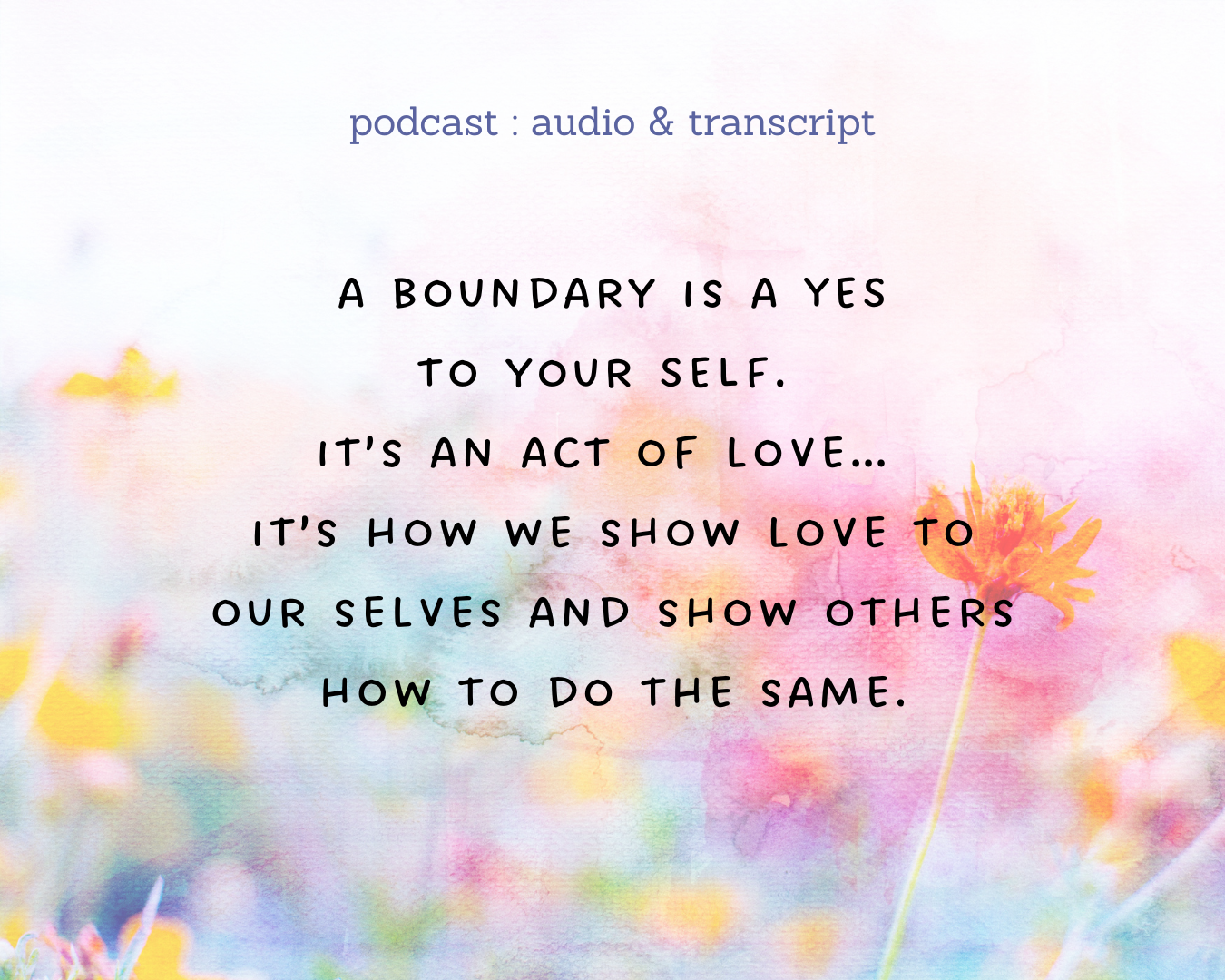
a boundary is a yes to your SELF. it’s an act of love… it’s how we show love to our selves and show others how to do the same.
thanks for joining me for this episode! phew it was a big one! i have created a worksheet to help you explore the ideas shared here!
you can grab that from the show notes at karenbrandy.com/explore. and for more, you might like to check out my new workbook: untethered. it’s all about strengthening your sense of self and exploring your inner parts, so that you can get unstuck and do more of what you want for your self. the workbook is perfect for those who are self directed and like to learn and explore on their own.
if you prefer further support and guidance, i offer that too – i always say that you are the hero of your own story, but every hero needs a sidekick! i would love to be yours.
find both the untethered workbook and ways to work with me at karenbrandy.com
i would also love to hear from you… how do you like to think about boundaries? what helps you set them and honour them?
in closing
i wish to acknowledge the Kaurna people, the traditional owners of the land on which i live, write, create, and teach… i also acknowledge the traditional custodians of the land on which you join me from.
i also wish to acknowledge that while i love to share from a variety of perspectives and therapies (including positive psychology, ACT, IFS, neuroscience, mindful self-compassion) i am not a therapist, nor an expert… i simply wish to share information and ideas that may offer insight and inspiration that YOU can use to lead your self out of stuckness and into the life you want for your self.
i also acknowledge my own privilege. whilst i am learning to lead myself through struggle i also have time, money, and support to do this work and that affords me the capacity that others may not have. some struggles will not be alleviated by self-help alone. my aim is to simply offer some new perspectives that might help shift things for you internally, no matter what further steps you decide to take.
thank you for joining me in this exploration of boundaries and the discomfort that can arise when we say yes to our selves.
until next time, keep shining.